


The SAIs of Bulgaria and Poland apply some aspects of AI of their activities
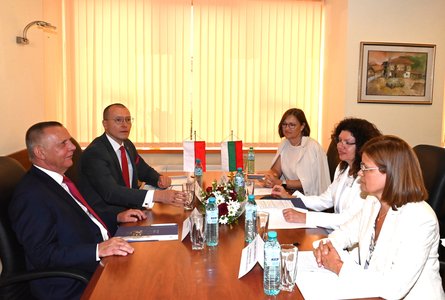
The Supreme Audit Institutions (SAIs) of Bulgaria and Poland have been actively developing the digitalization of their activities in recent years, and have lately also applied some aspects of artificial intelligence (AI) in their work. This became clear during the visit of a delegation of the SAI of Poland, led by its President Mr Marian Banas, to the Bulgarian National Audit Office (BNAO). The delegation also included Mr Grzegorz Haber, Member of the Council of the SAI of Poland, Director of the Department of Strategy.
From the Bulgarian side, the meeting was attended by the BNAO Vice-President Ms Margarita Nikolova, Maria Ilieva – Member of the BNAO, and Dobrinka Mihaylova, Head of the Planning, Reporting, Development and Quality of Audit Activities Unit.
AI, despite some risks, can be very useful in several areas: for quick and easy processing of big data, for preparing summaries of audit reports, for increasing the transparency of the results of audit activities for the public, as well as for easier and more accessible communication of these results to citizens, emphasized both Ms. Nikolova and Mr. Banas during the discussion.
The Supreme Audit Office of Poland uses AI to reach citizens by presenting the most important highlights of its audits and while preparing summaries of the audit reports, said Mr. Banas. The institution also actively uses infographics and other tools for visualizing the results of its audits.
The BNAO also prepares podcasts created with AI, based on press releases for its audit reports, to make the results of the audits easier to understand by the public. Over 80 percent of its audit work is digitalized, with audits carried out using specialized software.
Ms. Nikolova emphasized the important role of the Supreme Audit Office of Poland as one of the drivers for the dissemination of good audit practices within the European Organization of Supreme Audit Institutions. Dobrinka Mihaylova presented the structure, main goals and activity results of the BNAO, as well as the challenges the institution faces.
The representatives of both institutions agreed that conducting audits on topics important to society, for example in the field of the environment, is among the top priorities of their work. During the discussion were also mentioned the good bilateral relations between the two SAIs build over the years in the framework of the professional organizations. Opportunities for future cooperation through joint trainings, which could be held at the training center of the SAI of Poland, were discussed.
The independence of audit institutions was another important topic touched upon during the meeting. Mr. Banas shared the difficulties and problems that the Supreme Audit Office of Poland has faced in recent years, related to restrictions on the work of auditors and the scope of their activities, as a result of which the SIRAM* mechanism was activated. He added that as a result of the recommendations given by the international community and the actions taken, there has been an improvement and the Supreme Audit Office of Poland Annual Report for the past year has already been adopted by the Polish Parliament.
*SIRAM - Rapid Advocacy Mechanism for the Independence of Supreme Audit Institutions. A procedure that members of the International Organization of Supreme Audit Institutions can use when fundamental principles of independence in their work are violated.