


The BNAO Introduces Artificial Intelligence in Public Procurement Audits
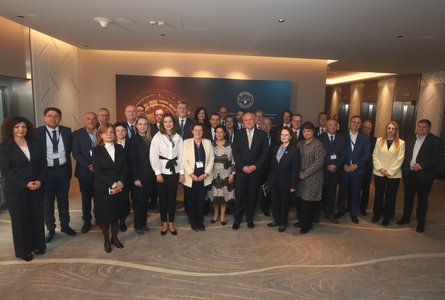
The Bulgarian National Audit Office is beginning to apply artificial intelligence in audits related to public procurement. The pilot project ODIS – an intelligent AI assistant – has been developed by the Institute for Computer Science, Artificial Intelligence and Technology (INSAIT) at Sofia University "St. Kliment Ohridski" specifically for the auditors of the Bulgarian National Audit Office. The technology was presented during the high-level international conference of the Bulgarian National Audit Office, marking the 145th anniversary of the establishment of the Supreme Audit Institution and the 30th anniversary of its re-establishment following the beginning of the democratic changes in Bulgaria.
The High-Level Conference “Artificial Intelligence and IT Audit in Safeguarding of the Public Resources” brought together Bulgarian and international experts. Participants included Prime Minister Rosen Zhelyazkov, Deputy Prime Minister Tomislav Donchev, Minister of e-Government Valentin Mundrov, Iliana Ivanova, Member of the European Court of Auditors, as well as speakers from the IT sector and academia. Special guests at the event were heads of Supreme Audit Institutions (SAIs) from various European countries.
“New technologies, and artificial intelligence in particular, provide us with opportunities for a new type of audit – one that is more transparent, more targeted and more effective. They enable us to detect anomalies in real time, identify patterns of behaviour that may point to potential irregularities or inefficiencies, and direct our efforts to areas where the risk to the public interest is greatest. Therefore, the Bulgarian National Audit Office considers the application of artificial intelligence in audit activities to be a strategic priority. We are at the beginning of building internal capacity in this area and believe that today’s conference will be highly beneficial not only for us, but also for all participants, in promoting the effective and responsible use of artificial intelligence in auditing,” said Dimitar Glavchev, President of the Bulgarian National Audit Office.
“ODIS is still in the training phase, but it will soon become a valuable assistant to auditors. I believe this will happen in an ethical and transparent manner, as every innovation in the public sector must be guided by the principles of legality, personal data protection and respect for human rights,” Dimitar Glavchev emphasised.
The platform will support auditors in verifying the legality and transparency of public procurement procedures by using publicly available data from the Electronic Public Procurement Platform.
“AI assistants will relieve auditors of repetitive tasks by automating routine activities. This will allow auditors to devote more time to analytical work. Auditors, however, will remain the supervisors of technologies designed to serve the public interest,” said Prime Minister Rosen Zhelyazkov. He also congratulated the Bulgarian National Audit Office on its strategic partnership with the Institute for Computer Science, Artificial Intelligence and Technology (INSAIT), noting that there is a natural connection between artificial intelligence and auditing, as both processes involve analysis, data discovery, forecasting and risk assessment.
“Bulgaria should have the ambition to become a provider of high-value AI services, rather than merely a user of such technologies. Our country is among the states that possess their own sovereign Bulgarian-language AI model and should make full use of all opportunities for its comprehensive and systematic application – not only within the public administration, but also through the provision of high-value services to businesses,” said Deputy Prime Minister and Minister of Innovation and Growth Tomislav Donchev. He congratulated the Bulgarian National Audit Office on introducing artificial intelligence into its audit activities, unlike other public institutions which, in his words, still approach these technologies with caution and apprehension.
“Artificial intelligence develops through the data on which it is trained – some of this data is publicly available, but it often includes sensitive or personal information. Protecting such data must be our primary priority,” emphasised Minister of e-Government Valentin Mundrov. He pointed out that it is necessary to find the right balance between data usability and the protection of privacy through encryption and strict access standards. “If this balance is disrupted, we risk data being used maliciously and without adequate control, which could endanger citizens’ rights,” the Minister of e-Government stressed.
Iliana Ivanova shared the European Court of Auditors’ experience and good practices in the field of artificial intelligence, while Eng. Borislav Petrov, Chief Executive Officer of INSAIT, spoke about the establishment and development of the research institute, which is among the world's leading institutions in this field.
Other speakers at the conference included Sylvia Peneva, Country Managing Partner, Audit & Assurance at Deloitte Bulgaria, Dobroslav Dimitrov, Chairman of BRAIT and member of the Advisory Board of BASSCOM, Alvar Nõuakas, Head of the Secretariat of the EUROSAI IT Working Group, Dafina Dimitrova, Assistant Director General, SAI Governance, at the INTOSAI Development Initiative (IDI), and Associate Professor Dr Agata Manolova, Dean of the Faculty of Telecommunications at the Technical University of Sofia. Tsvetana Mateva, Chief Expert at the Planning, Reporting, Development and Audit Quality Management Unit of the Bulgarian National Audit Office, presented the first steps taken in introducing artificial intelligence within the institution.
In addition to the international conference on artificial intelligence, the Bulgarian National Audit Office celebrated its anniversary with a light show featuring 3D projection mapping, which was displayed on the façade of the Regional History Museum – Sofia on 9 November.
As part of the anniversary celebrations, the Bulgarian National Audit Office is also offering three students the opportunity to participate in a three-month paid internship programme.
Following a competitive selection process, the following finalists were chosen:
Elena Petrova, a fourth-year student in Financial Control at the University of National and World Economy (UNWE);
Kaloyan Genchev, a fourth-year student in Economics and Finance (English programme) at Sofia University “St. Kliment Ohridski”;
Nyursen Suleyman, a fourth-year student in Business Administration (German programme) at Sofia University “St. Kliment Ohridski”.