


Half of Bulgarian citizens expect harsher sanctions by the Bulgarian National Audit Office for misuse and wasteful spending of taxpayers’ money
The Bulgarian National Audit Office should provide taxpayers with assurance that their money is not being misused. The audit institution is expected to impose more significant sanctions in cases of illegal use of public funds, as well as where public money is spent without any real benefit to the state and its citizens. It is to play a key role in the fight against corruption and serve as a moral and institutional corrective to governance. The institution should take alerts from citizens into account when planning its audits, while the National Assembly is expected to pay greater attention to audit findings.
These are the expectations that citizens have of the Bulgarian National Audit Office, according to a representative sociological survey commissioned by the audit institution and conducted by Research Center Trend.
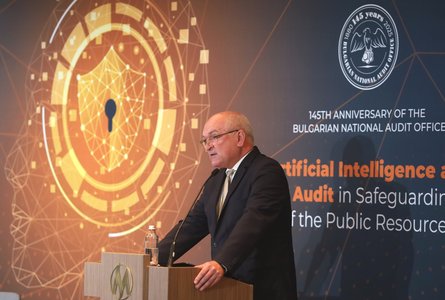
The survey was presented at the High-Level Conference “Artificial Intelligence and IT Audit in Safeguarding of the Public Resources”, which marked two important anniversaries in the history of the Bulgarian National Audit Office: the 145th anniversary of its establishment and the 30th anniversary of the re-establishment of the audit institution.
The survey was conducted between 13 and 20 September 2025 through face-to-face interviews with 1,001 respondents aged 18 and above. The topic of the survey was “Public Attitudes towards the Bulgarian National Audit Office and the Use of Artificial Intelligence”.
More than half of the respondents (52 per cent) primarily associate the Bulgarian National Audit Office with its function of “examining how all public funds are spent”. For 37 per cent, it is a state institution independent of the executive power. Seventeen per cent identify it with its function of auditing the financial reporting of political parties and coalitions.
In response to the question as to which organisations are subject to audit by the Bulgarian National Audit Office, the largest share of respondents (42 per cent) indicated municipalities and the state budget, followed by ministries (40 per cent), and the National Assembly, the Council of Ministers and the Administration of the President (36 per cent). Of particular interest is the fact that 28 per cent of respondents associate the Bulgarian National Audit Office with oversight of political parties.
The survey data also show that the largest share of respondents associate the institution with media reports on cases of financial irregularities uncovered during its audits (32 per cent). Ranked second (23 per cent) is the issue of oversight of the financing of election campaigns, donations and subsidies to political parties. This indicates that the Bulgarian National Audit Office is also perceived as having a supervisory role in relation to the political system, although to a more limited extent.
Fifty-eight per cent of Bulgarians believe that their expectations of the Bulgarian National Audit Office are related to providing taxpayers with greater assurance that their money is not being misused, while 52 per cent expect the institution to impose more significant sanctions in cases of illegal use of budgetary funds, as well as where taxpayers’ money is spent without any real benefit to the state and its citizens.
More Audits in the Following Areas:
Citizens believe that the Bulgarian National Audit Office should carry out more audits in the area of local government and municipalities (44 per cent). The second most frequently mentioned area is industry and energy (40 per cent), with society expecting the audit institution to play a key role in ensuring transparency in the management of state-owned enterprises and infrastructure projects in this sector.
Social policy ranks third (36 per cent). This reflects public sensitivity to the way social benefits, pensions and funds for vulnerable groups are allocated. Justice is also among the priorities (31 per cent).
The Role of Artificial Intelligence
Thirty per cent of Bulgarians familiar with the Bulgarian National Audit Office believe that the introduction of artificial intelligence will assist auditors but will not be able to replace them in all assessments and activities, while 25 per cent share the view that artificial intelligence generates information and conclusions, but that these need to be verified by human judgement. Only 6 per cent believe that artificial intelligence could completely replace auditors.
Overall, 48 per cent express a positive view of the transformative role of AI, 11 per cent expect its impact to be limited, while 8 per cent are entirely sceptical.
However, 44 per cent believe that, with the help of artificial intelligence, the Bulgarian National Audit Office will be able to carry out its audits much more quickly and efficiently.
Respondents see opportunities for improving the work of the Bulgarian National Audit Office in the following areas:
- automatic analysis of large volumes of data (42 per cent);
- detection of irregularities and risks in real time (38 per cent);
- preparation of reports and audit reports (20 per cent);
- enhancing transparency (16 per cent);
- communication with institutions and citizens (11 per cent).
Risks
The lack of human judgement is identified by the largest share of respondents (34 per cent) as a potential risk associated with the use of AI in the work of institutions exercising control functions. Data misuse (27 per cent) and possible errors in algorithms rank second and third, respectively. The combination of these three risks indicates that public concerns are both technological and ethical in nature.
Seventeen per cent see a risk of insufficient transparency of processes, while 11 per cent point to the possibility of violations of the rights of audited entities.